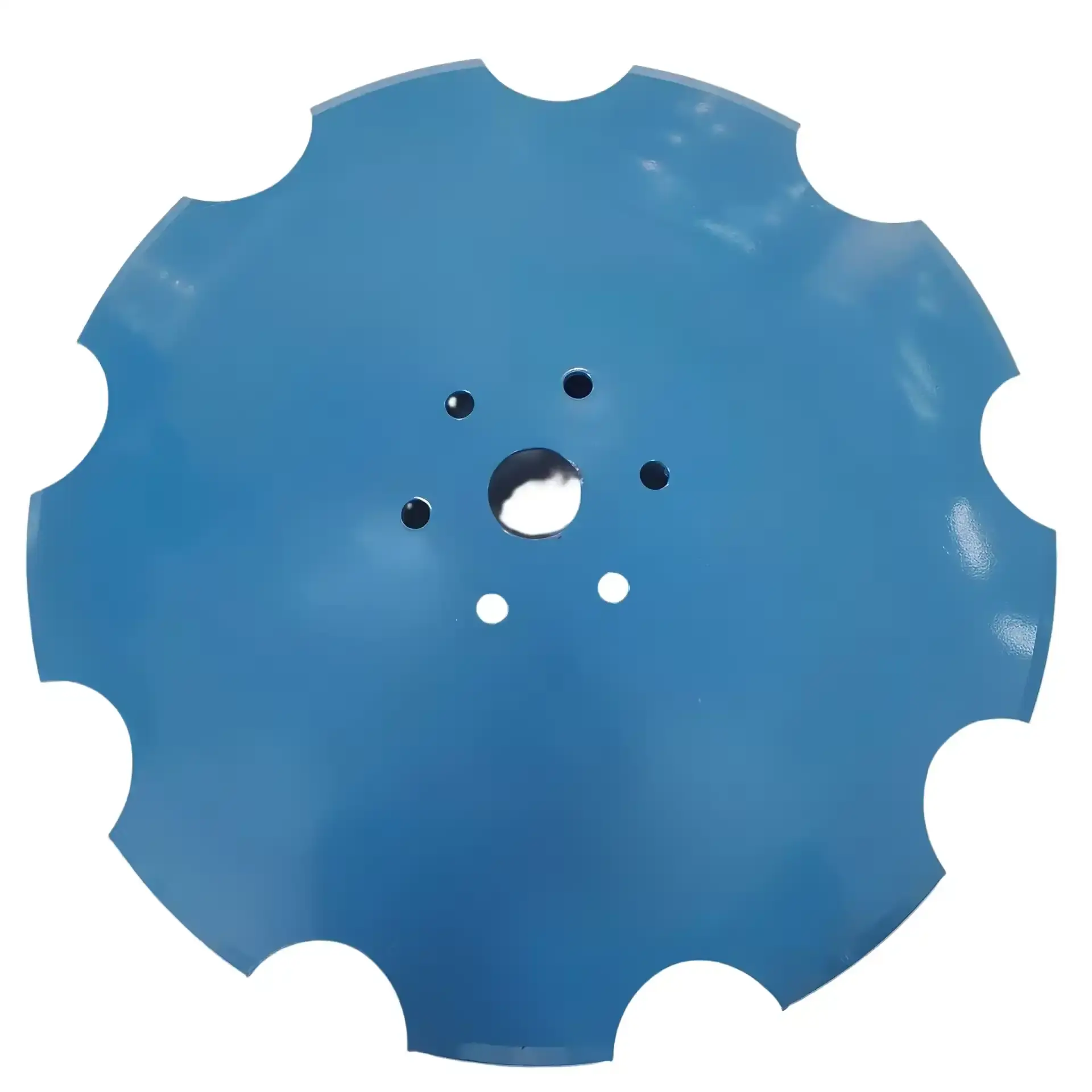
Disc blades, also called disc harrow blades or plow discs, are the concave cutting discs mounted on a disc harrow. In Spanish-language searches they are often called discos para rastra. Buyers use them to till soil before planting or, at the end of the season, to chop leftover residue. The edge, diameter, thickness, center hole, and concavity all have to match the machine. A blade that looks similar in a photograph is not automatically a replacement.
This article explains how plain and notched blades differ, which options appear on Scican Machinery's disc blade category and disc blade product page , and what to record before you ask for a review. It does not assign wear limits, cutting depths, or hardness values that are not published on those pages, and it is not a claim that a listed blade is an official spare for a particular harrow brand.
What a disc blade does on the harrow
On a disc harrow, each blade is a steel disc with a curved, or concave, face. As the gang rotates, the edge cuts, and the concavity moves and mixes soil. The job changes with the pass: a first pass over heavy residue or hard ground is not the same as a finishing pass that is meant to leave a smoother seedbed.
The blade is only one part of the implement. Spacing, gang angle, ballast, and the condition of the scrapers and bearings also affect how the disc works in the field. If you are also reviewing the tractor driveline that powers other tillage machines, the gearbox on a rotary tiller is a different component and is specified separately.
Plain and notched edges
Scican's product description distinguishes two main types by the edge of the blade: notched disc blades and plain disc blades.
A plain, or smooth, blade has a continuous edge. It is generally chosen when the ground has already been opened, when the goal is a finer finish, or when the field has a lot of stone and a notched edge is more likely to catch and crack at the root of a cut-out. A notched blade has recesses in the edge. The notches help the disc bite into residue and harder ground instead of riding over it. Many two-gang harrows are set up with notched blades in the front gang and plain blades in the rear gang, so the front cut opens the soil and the rear gang levels what the front leaves behind. That arrangement is common practice; it is not a rule that every machine must follow, and rocky fields sometimes use plain blades in both gangs.
Notch patterns are not all the same. If you are replacing a notched disc, a photograph of the edge is more useful than the word "notched" alone. Combination or fluted blades exist on some tillage tools, but they are not listed on Scican's current disc blade product page, so this article does not treat them as stock options.
Diameter, thickness, and concavity
The published disc blade page lists blades from 12 inches to 36 inches in diameter, with thicknesses from 2 mm (14 gauge) to 10 mm (3 gauge), and with standard and deep cone concavities. Those ranges describe what can be discussed; they are not a suggestion to fit a larger or thicker disc than the harrow was built for.
Diameter and thickness have to be read from the existing disc or from the machine documentation, not guessed from tractor horsepower. A larger disc changes working depth and clearance. A thicker disc changes weight and how the gang is loaded. Two discs of the same diameter can still have different concavity, and mixing curves in the same gang leaves an uneven cut. Measure concavity on the hollow face, from a straightedge laid across the disc to the center, and say whether you need the standard or deep cone option listed on the product page.
The same page lists the normal materials as 65Mn and 30MnB5. Those are the grades Scican publishes for this product. Do not copy a steel grade, hardness number, or service-life claim from another supplier's catalog and treat it as a specification for a Scican blade.
What to measure before you order
If the blade is badly worn, take the diameter from a less worn disc on the same gang or from the harrow manual. A worn edge understates the original size.
Outside diameter, edge to edge through the center. On a notched disc, measure from tip to tip.
Thickness next to the center hole, not at the cutting edge, which is thinner from wear and sharpening.
Center hole: square, round, or a bolted flange. For a square hole, measure side to side, not diagonally. For a round hole, measure the diameter. For a flange, count the bolt holes, measure each hole, and measure the pitch circle that their centers form.
Edge type: plain or notched, plus a photo of the edge.
Concavity, and whether the current disc is a standard or deep cone.
Position on the machine: front or rear gang, and how many discs you intend to replace.
Write the replacement as diameter by thickness and edge type, and attach photos of the disc, the center hole, and the harrow nameplate when one is present.
Replacing one disc in a worn gang
A new disc in a gang of worn discs will usually run deeper and take more of the load. Unless the manufacturer of your harrow says otherwise, plan to replace a complete gang, or at least a matched set of the same diameter, thickness, edge, and concavity. Cracks, a loose center hole, or an edge that has become so dull that the disc pushes soil instead of cutting it are also reasons to review the set. This article does not give a universal wear percentage. If your machine manual states a minimum diameter, follow that figure.
What to send with an inquiry
Scican's disc blade category is set up so buyers can compare the published options and then send a technical inquiry. The product page also notes a minimum order of 50 pieces, which matters when you plan quantity. For a precise reply, include:
Harrow make, model, and photos of the existing discs and nameplate
The measurements listed above
Soil and residue conditions, if they affect whether you want plain or notched edges
Quantity, destination, and purchase timing
Whether a standard catalog size is acceptable or a drawing needs review
You can start from the disc blade category or the disc blade product page , then use the contact page to send the details. Scican can review a standard replacement or, when the published sizes are not enough, a custom request that includes drawings, material requirements, and working conditions.
Application reference for machinery buyers
Use this article as a practical reference when comparing agricultural gearbox, PTO drive shaft, disc blade, or rotary cutter component requirements.
For a precise recommendation, prepare the machine type, working conditions, shaft or blade dimensions, required ratio or torque, installation photos, and any existing nameplate information before inquiry.
Scican Machinery can review standard replacement needs and custom component requirements, then confirm the practical next step for quotation or technical discussion.
When a case mentions South American field work, rotary cutters, seeders, or heavy residue, focus on the load pattern behind the example. Crop residue, soil moisture, tractor horsepower, daily working hours, and operator habits all affect gearbox selection. These details help separate a general product match from a practical field recommendation.
Before comparing models, write down the input speed, output speed, shaft direction, mounting face, center distance, lubrication method, and any known failure symptoms. If the old part overheated, leaked oil, broke teeth, or produced noise, include that symptom with photos. The same model name can still require a different review when the working load or installation space changes.
For replacement projects, send photos from several angles: the complete implement, gearbox housing, input shaft, output shaft, mounting bolts, blade carrier, and nameplate. A ruler or caliper in the photo helps confirm scale. If drawings are available, include the shaft diameter, spline count, keyway size, hole spacing, and housing height.
For batch purchasing, explain whether the parts are for maintenance stock, distributor inventory, or new machine assembly. Quantity, target market, packaging needs, destination country, inspection requirements, and expected delivery time all affect how the quotation is prepared. Clear purchasing context reduces repeated emails and makes technical confirmation faster.
If the article describes a gearbox used with rotary cutters, seeders, or other field implements, also check the surrounding parts. A gearbox that looks correct can still fail early when the PTO shaft angle is too steep, the blade carrier is unbalanced, the mounting surface is distorted, or lubrication intervals are ignored. Sharing these surrounding conditions gives the technical review a more complete picture.
Maintenance information is useful even when the purchase is for a new unit. Tell us whether the implement works seasonally or year-round, whether the operator can inspect oil level regularly, and whether spare seals, bearings, or shafts are needed with the order. These notes help buyers compare total operating reliability, not only the first purchase price.
Custom review is usually needed when the old gearbox is no longer available, the implement maker changed the mounting pattern, or the buyer wants a different shaft, ratio, housing, or output direction. In those cases, the article can help define the application, but drawings and measurements still decide whether the project is realistic.
This article should be treated as an application guide, not a final specification sheet. The practical next step is to compare the article scenario with your own machine, then send the missing details for review. Scican Machinery can use that information to confirm whether an existing gearbox, an adapted configuration, or a custom component discussion is the right path.
Inquiry checklist for replacement and custom parts
Start with the practical job that the machine must complete. For a rotary cutter, explain the crop residue, cutting height, tractor horsepower, PTO speed, blade carrier size, and expected working hours. For a seeder, explain soil type, row spacing, planting speed, and whether the drivetrain must handle sudden load changes. The same gearbox family can behave differently when the field load, implement weight, and operator habit change.
Record the existing part before removing it from the machine. Useful photos include the complete implement, the old gearbox mounted in place, the input shaft, output shaft, mounting face, bolt holes, seals, oil plug, and any nameplate. A photo with a ruler or caliper helps confirm scale. When a shaft has splines, count the spline number and measure the outside diameter instead of relying only on the model name.
Measure the mounting area carefully. Buyers often compare the overall housing height, input shaft position, output shaft position, flange size, bolt spacing, shaft direction, and clearance around guards or frames. A gearbox that matches the ratio can still be unsuitable if the housing touches the implement frame or if the shaft direction forces the PTO to work at an unsafe angle.
Describe the failure reason if this is a replacement project. Broken teeth, oil leakage, overheating, cracked housing, bearing noise, seal damage, or repeated shaft wear each points to a different review path. A direct replacement may be enough for normal wear, but repeated failure can mean the application needs another ratio, stronger housing, better lubrication practice, or a review of nearby components.
For batch purchasing, separate technical confirmation from commercial confirmation. Technical confirmation needs drawings, photos, dimensions, ratio, torque, speed, and material expectations. Commercial confirmation needs quantity, destination country, packaging method, inspection requirement, delivery window, and whether the order is for maintenance stock, distributor resale, or new machine assembly. Clear separation makes the quotation faster and reduces repeated questions.
If the article describes an application case, compare the case with your own use instead of copying it directly. South American rotary cutter work, seeders in mixed soil, and industrial power transmission each have different load patterns. The useful lesson is the selection logic: identify load, confirm fit, check surrounding parts, and then decide whether a standard model or customized configuration is practical.
Maintenance context also matters during a purchase discussion. Share whether the equipment works seasonally or every day, whether operators can check oil level, whether seals and bearings are easy to service, and whether spare parts should be shipped with the main unit. These details help compare long-term operating reliability instead of only comparing the first purchase price.
When drawings are available, include them early. A simple drawing with shaft diameter, keyway, spline count, center distance, mounting hole spacing, housing height, rotation direction, and ratio can prevent misunderstandings. If there is no drawing, clear photos plus measured dimensions are still useful. The goal is to turn a general product inquiry into a review that can be checked by engineering and sales together.
For custom components, be clear about what can change and what must remain fixed. Some projects only need a shaft, seal, or mounting adjustment; others need a different housing, bearing arrangement, ratio, output direction, or material choice. Custom review is more realistic when the buyer explains the target machine, working environment, annual quantity, expected service life, and any previous supplier problem.
Quality confirmation should be discussed before the order is finalized. Ask which dimensions will be checked, whether sample confirmation is needed, how packaging protects shafts and machined surfaces, and whether photos or inspection notes can be shared before shipment. For maintenance buyers, a small documentation set can be more useful than a long catalog page because it connects the shipped part with the machine that will receive it.
Logistics details can also affect the final recommendation. Heavy gearbox parts, long PTO shafts, and sharp disc blades have different packing and transport needs. Tell the supplier whether the shipment goes to a workshop, distributor warehouse, farm, or machine builder. Destination, unloading conditions, labeling needs, and spare-part grouping can change how the order should be packed and how the delivery schedule should be planned.
Before sending the inquiry, prepare one concise message: machine type, application, old part photos, key dimensions, ratio or speed requirement, quantity, destination, and expected timing. This article can help organize the questions, but the final recommendation depends on the real machine data. Scican Machinery can then review whether an existing product, adapted configuration, or custom discussion is the right next step.
Article FAQ
How should I use this article before sending an inquiry?
Use it to identify the machine type, application, working load, and product details that need confirmation. Then send photos, dimensions, quantity, and any nameplate information with the inquiry.
Can Scican Machinery review a similar application that is not shown in the article?
Yes. If the application is similar but not identical, share the working conditions, drawings, installation space, and replacement target so the team can review whether a standard or adapted component is practical.
What details make the technical reply faster?
Clear photos, mounting dimensions, shaft or blade size, ratio, torque estimate, usage frequency, destination country, and expected quantity help reduce repeated emails and improve the first technical reply.