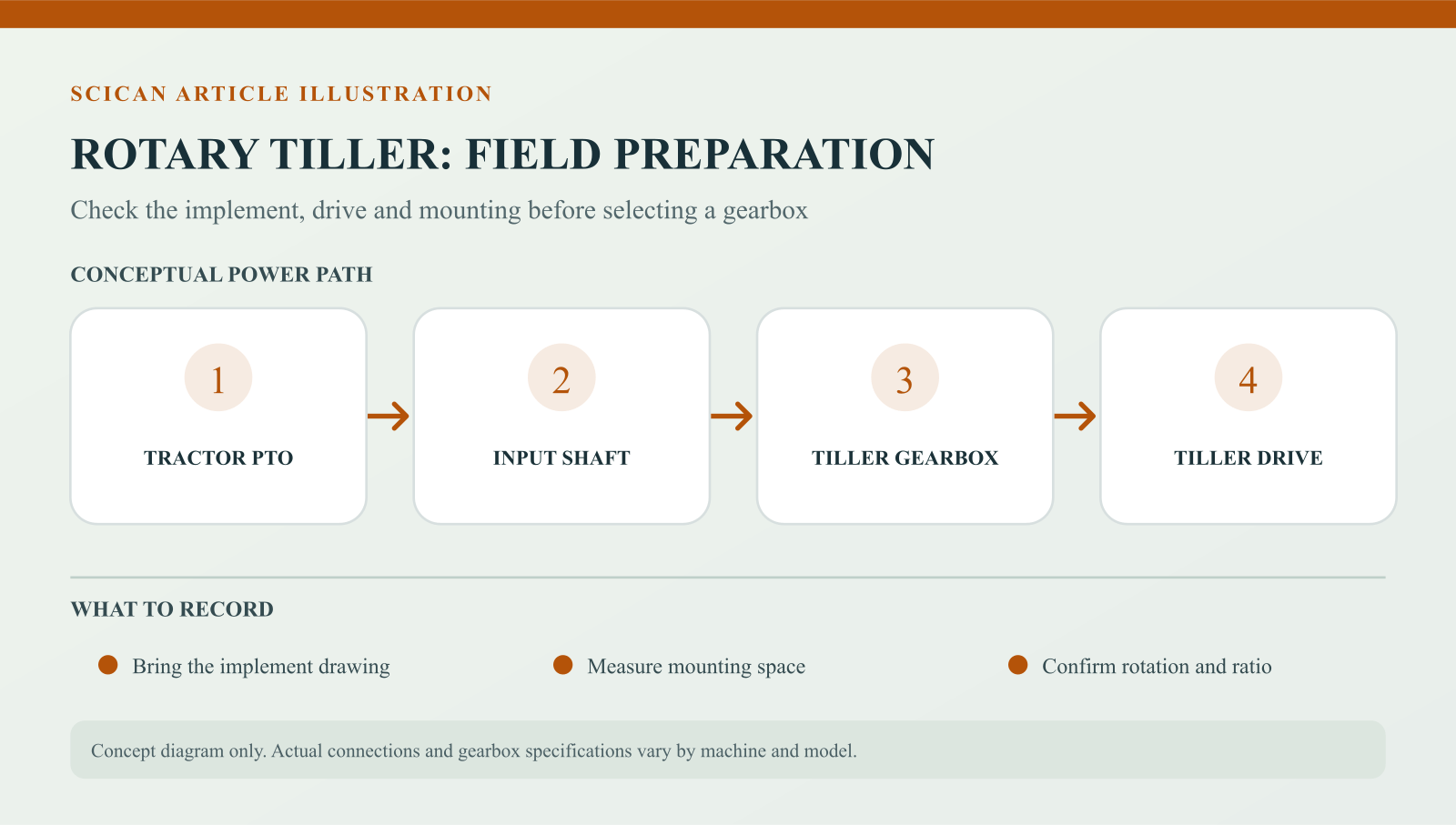
Before a rotary tiller enters a field, the buyer or maintenance team needs to know which implement the gearbox must serve and how it connects to the rest of the drive. Soil condition and the planned work help explain the application, but they cannot replace mounting dimensions, shaft connections and the required gear ratio.
For a new implement, begin with the design
Provide the tiller drawing or machine model, rotor arrangement, drive connection and space available for the gearbox. State the required input and output directions. If the design specifies speeds or a gear ratio, identify the drawing or manual from which those figures come. Do not carry them over from an old product that merely looks similar.
The PTO , or power take-off, is the tractor connection that supplies power to an implement. A gearbox is part of the path from that input to the tiller's working components. The same broad product name can cover different installation arrangements, so the machine design must guide the comparison.
For a replacement, document the unit before removal
Photograph the gearbox in position and show the components attached around it. After removal, photograph its nameplate, mounting face, shaft ends and every side. Measure mounting-hole spacing, accessible shaft dimensions and clearance within the frame. Compare what you measured with the machine's documentation where possible.
On a machine that has been repaired or modified before, the installed gearbox may not be its original factory configuration. Tell the supplier about such changes. This helps prevent a catalog match based on the machine name from being mistaken for a match to the part actually installed.
Describe symptoms without guessing the cause
If the tiller shows oil leakage, a new noise or vibration during work, record when the symptom occurs and how it has changed. These observations guide inspection; they do not prove which internal component is at fault. Diagnosis should take the actual machine and its maintenance instructions into account.
Combine the implement model, work description, old-part photographs, measured dimensions, known drive requirements, quantity, destination and purchasing date in one inquiry. Scican Machinery's rotary tiller gearbox category provides a starting list of candidates; the final choice requires confirmation against the specific implement.
Application reference for machinery buyers
Use this article as a practical reference when comparing agricultural gearbox, PTO drive shaft, disc blade, or rotary cutter component requirements.
For a precise recommendation, prepare the machine type, working conditions, shaft or blade dimensions, required ratio or torque, installation photos, and any existing nameplate information before inquiry.
Scican Machinery can review standard replacement needs and custom component requirements, then confirm the practical next step for quotation or technical discussion.
When a case mentions South American field work, rotary cutters, seeders, or heavy residue, focus on the load pattern behind the example. Crop residue, soil moisture, tractor horsepower, daily working hours, and operator habits all affect gearbox selection. These details help separate a general product match from a practical field recommendation.
Before comparing models, write down the input speed, output speed, shaft direction, mounting face, center distance, lubrication method, and any known failure symptoms. If the old part overheated, leaked oil, broke teeth, or produced noise, include that symptom with photos. The same model name can still require a different review when the working load or installation space changes.
For replacement projects, send photos from several angles: the complete implement, gearbox housing, input shaft, output shaft, mounting bolts, blade carrier, and nameplate. A ruler or caliper in the photo helps confirm scale. If drawings are available, include the shaft diameter, spline count, keyway size, hole spacing, and housing height.
For batch purchasing, explain whether the parts are for maintenance stock, distributor inventory, or new machine assembly. Quantity, target market, packaging needs, destination country, inspection requirements, and expected delivery time all affect how the quotation is prepared. Clear purchasing context reduces repeated emails and makes technical confirmation faster.
If the article describes a gearbox used with rotary cutters, seeders, or other field implements, also check the surrounding parts. A gearbox that looks correct can still fail early when the PTO shaft angle is too steep, the blade carrier is unbalanced, the mounting surface is distorted, or lubrication intervals are ignored. Sharing these surrounding conditions gives the technical review a more complete picture.
Maintenance information is useful even when the purchase is for a new unit. Tell us whether the implement works seasonally or year-round, whether the operator can inspect oil level regularly, and whether spare seals, bearings, or shafts are needed with the order. These notes help buyers compare total operating reliability, not only the first purchase price.
Custom review is usually needed when the old gearbox is no longer available, the implement maker changed the mounting pattern, or the buyer wants a different shaft, ratio, housing, or output direction. In those cases, the article can help define the application, but drawings and measurements still decide whether the project is realistic.
This article should be treated as an application guide, not a final specification sheet. The practical next step is to compare the article scenario with your own machine, then send the missing details for review. Scican Machinery can use that information to confirm whether an existing gearbox, an adapted configuration, or a custom component discussion is the right path.
Inquiry checklist for replacement and custom parts
Start with the practical job that the machine must complete. For a rotary cutter, explain the crop residue, cutting height, tractor horsepower, PTO speed, blade carrier size, and expected working hours. For a seeder, explain soil type, row spacing, planting speed, and whether the drivetrain must handle sudden load changes. The same gearbox family can behave differently when the field load, implement weight, and operator habit change.
Record the existing part before removing it from the machine. Useful photos include the complete implement, the old gearbox mounted in place, the input shaft, output shaft, mounting face, bolt holes, seals, oil plug, and any nameplate. A photo with a ruler or caliper helps confirm scale. When a shaft has splines, count the spline number and measure the outside diameter instead of relying only on the model name.
Measure the mounting area carefully. Buyers often compare the overall housing height, input shaft position, output shaft position, flange size, bolt spacing, shaft direction, and clearance around guards or frames. A gearbox that matches the ratio can still be unsuitable if the housing touches the implement frame or if the shaft direction forces the PTO to work at an unsafe angle.
Describe the failure reason if this is a replacement project. Broken teeth, oil leakage, overheating, cracked housing, bearing noise, seal damage, or repeated shaft wear each points to a different review path. A direct replacement may be enough for normal wear, but repeated failure can mean the application needs another ratio, stronger housing, better lubrication practice, or a review of nearby components.
For batch purchasing, separate technical confirmation from commercial confirmation. Technical confirmation needs drawings, photos, dimensions, ratio, torque, speed, and material expectations. Commercial confirmation needs quantity, destination country, packaging method, inspection requirement, delivery window, and whether the order is for maintenance stock, distributor resale, or new machine assembly. Clear separation makes the quotation faster and reduces repeated questions.
If the article describes an application case, compare the case with your own use instead of copying it directly. South American rotary cutter work, seeders in mixed soil, and industrial power transmission each have different load patterns. The useful lesson is the selection logic: identify load, confirm fit, check surrounding parts, and then decide whether a standard model or customized configuration is practical.
Maintenance context also matters during a purchase discussion. Share whether the equipment works seasonally or every day, whether operators can check oil level, whether seals and bearings are easy to service, and whether spare parts should be shipped with the main unit. These details help compare long-term operating reliability instead of only comparing the first purchase price.
When drawings are available, include them early. A simple drawing with shaft diameter, keyway, spline count, center distance, mounting hole spacing, housing height, rotation direction, and ratio can prevent misunderstandings. If there is no drawing, clear photos plus measured dimensions are still useful. The goal is to turn a general product inquiry into a review that can be checked by engineering and sales together.
For custom components, be clear about what can change and what must remain fixed. Some projects only need a shaft, seal, or mounting adjustment; others need a different housing, bearing arrangement, ratio, output direction, or material choice. Custom review is more realistic when the buyer explains the target machine, working environment, annual quantity, expected service life, and any previous supplier problem.
Quality confirmation should be discussed before the order is finalized. Ask which dimensions will be checked, whether sample confirmation is needed, how packaging protects shafts and machined surfaces, and whether photos or inspection notes can be shared before shipment. For maintenance buyers, a small documentation set can be more useful than a long catalog page because it connects the shipped part with the machine that will receive it.
Logistics details can also affect the final recommendation. Heavy gearbox parts, long PTO shafts, and sharp disc blades have different packing and transport needs. Tell the supplier whether the shipment goes to a workshop, distributor warehouse, farm, or machine builder. Destination, unloading conditions, labeling needs, and spare-part grouping can change how the order should be packed and how the delivery schedule should be planned.
Before sending the inquiry, prepare one concise message: machine type, application, old part photos, key dimensions, ratio or speed requirement, quantity, destination, and expected timing. This article can help organize the questions, but the final recommendation depends on the real machine data. Scican Machinery can then review whether an existing product, adapted configuration, or custom discussion is the right next step.
Article FAQ
How should I use this article before sending an inquiry?
Use it to identify the machine type, application, working load, and product details that need confirmation. Then send photos, dimensions, quantity, and any nameplate information with the inquiry.
Can Scican Machinery review a similar application that is not shown in the article?
Yes. If the application is similar but not identical, share the working conditions, drawings, installation space, and replacement target so the team can review whether a standard or adapted component is practical.
What details make the technical reply faster?
Clear photos, mounting dimensions, shaft or blade size, ratio, torque estimate, usage frequency, destination country, and expected quantity help reduce repeated emails and improve the first technical reply.